
My current positions are listed under Trade Disclosure, above Talk Your Book.
No new trade is attached to this note.
Figures from company filings and releases to 30 October 2026, including Amazon's 10-Q.
Why an Update
As I write, the stock market is selling off, with the Magnificent Seven and the semiconductor shares leading it down. The semiconductors' bounce this week had the look of a dead cat. The largest companies flattered on headline growth and capital spending, but the market has started asking the question this series has asked since August: what return will all that capital earn, and when?
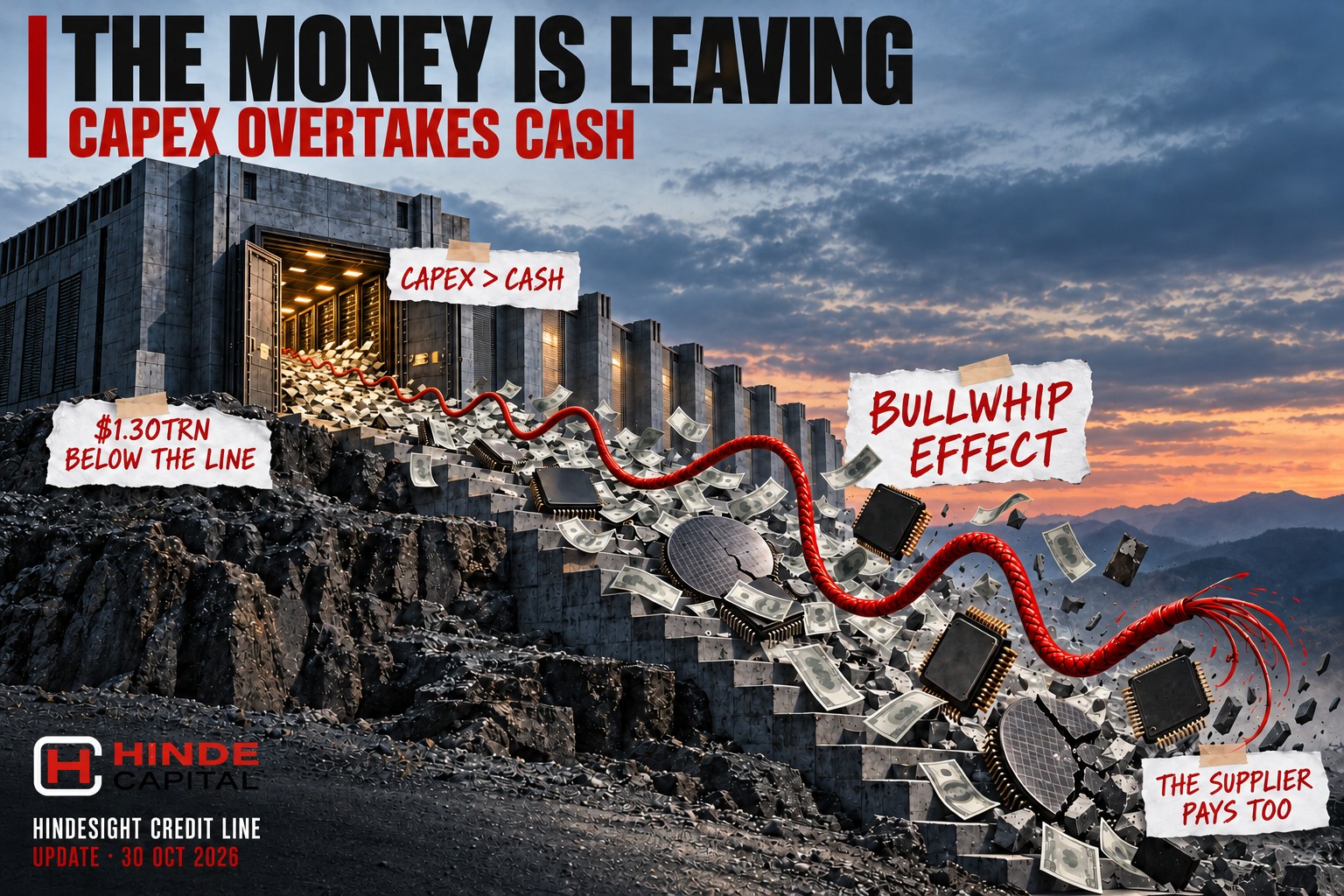
The third-quarter results give an answer of sorts. The cash has turned, and four of the five largest builders now spend more on capital than their operations bring in. The commitments have moved below the line, with $1.30trn of leases signed but not yet started. And the bill is travelling up the supply chain, to suppliers like Intel that must now finance the factories as well as sell the chips. The money is leaving.
The November Credit Line went out before Amazon and Intel reported, and before Alphabet and Amazon filed their 10-Qs. All of that is now in, and the picture has moved in one direction.
For most of the AI boom, the hyperscalers paid for their ambitions from businesses they had already built. Advertising, search, retail and software produced the cash; data centres consumed it; shareholders collected what was left through buybacks. That arrangement is ending. Four of the five largest builders now spend more on capital than their operations bring in, and the fifth has changed how it counts.
These are not struggling businesses. Amazon Web Services grew 39% in the third quarter and Google Cloud 103%. The revenues are real. What is new is that capital spending has grown fast enough to consume the cash of businesses that, until recently, looked incapable of running out of it.
The Cash
Amazon's free cash flow for the twelve months to September was minus $42.4bn, against plus $14.8bn a year earlier. Its net purchases of property and equipment rose $94.8bn in a year, which Amazon attributes mainly to AI.1 Alphabet has now had two negative quarters in a row, minus $5.9bn and minus $9.1bn.2 Meta followed at minus $2.1bn,3 Oracle at minus $5.4bn even after $11.4bn of customer prepayments.4 Microsoft remains comfortably positive.5
| Company | Period | Operating cash flow | Capital spending | Free cash flow |
|---|---|---|---|---|
| Amazon | 12 months to Sep 2026 | $168.3bn | $210.7bn (net) | −$42.4bn |
| Alphabet | Q3 2026 | $42.3bn | $51.4bn | −$9.1bn |
| Oracle | Q1 FY2027 (Jun–Aug 2026) | $23.1bn | $28.5bn | −$5.4bn |
| Meta | Q3 2026 | $32.8bn | $34.9bn (incl. finance-lease principal) | −$2.1bn |
| Microsoft | Q1 FY2027 (Jul–Sep 2026) | $58.0bn | $39.4bn | +$18.6bn* |
Each company's own definitions, and different periods, so the direction matters more than the comparison. *Microsoft reports no free-cash-flow line; this is operating cash flow less cash property additions, our arithmetic. Without its prepayments, Oracle's figure would be nearer minus $17bn, also our arithmetic.
HS Chart NoteAmazon still generates more operating cash than ever, $168.3bn over twelve months. Spending on property and equipment simply grew faster, by $94.8bn in a year, and overtook it this year. The cash machine has become a cash consumer.
The spending is not slowing. Amazon has held its 2026 guidance at about $220bn, Alphabet at $195bn to $205bn and Meta at $135bn to $145bn, and Alphabet says 2027 will rise significantly. The marginal dollar that once bought back shares now buys computing capacity, and Meta bought back none at all last quarter, against $3.3bn a year earlier.
The Bill Below the Line
Of the twelve principles in October's Below the Line, the simplest has become the most revealing: signing is not recognition. A data-centre lease reaches the balance sheet only when the building is ready. Until then it sits in a note, at the undiscounted value of the payments to come. The latest filings show how fast those promises are piling up.
HS Chart NoteSigning is not recognition. These leases reach the balance sheet only when the buildings are ready, but the decision has already been taken. The balance sheet is waiting for the building. The commitment is not.
The four that report on a September quarter added $185bn between them in three months: Meta $76.7bn, Alphabet $45.3bn, Microsoft $35.5bn and Amazon $27.7bn.
It would be wrong to call the $1.30trn debt payable today; it runs over many years, and some of it is still conditional. It would be equally wrong to treat it as discretionary. Most of the decision has already been taken. The balance sheet is waiting for the building. The commitment is not.
The purchase commitments run further. Meta reports $454.5bn of non-cancellable contractual commitments, much of it for cloud capacity, servers and power. Alphabet's 10-Q puts its material purchase commitments at $924.4bn, $213.4bn of them due within a year, and its data-centre backstops for partners now total $75.7bn: $48.0bn already executed as credit derivatives, carried as a liability of just $0.61bn, and $27.7bn still to be put in place. Its financial guarantees tripled to $22.8bn in a quarter, $6.6bn of them promises to buy back its own TPUs. These cannot simply be added to the leases: some support the same buildings, and the same contract is a cost to the tenant and backlog to the landlord. Below the Line called it seeing the same contract from different chairs.
The Five Builders
Amazon: the cash machine becomes a cash consumer. Operating cash flow rose 29% to $168.3bn over twelve months, and capital spending rose faster still. AWS's 39% growth is strong evidence that customers want the capacity. It is not evidence that today's rate of spending earns its cost. Amazon is also both an investor in Anthropic and one of its largest suppliers, so the economics of its cloud and the financing of one of its biggest customers are increasingly the same question. Its 10-Q, filed on 30 October, shows what sits below the line. Leases signed but not yet started rose $27.7bn in the quarter to $164.9bn, and purchase commitments reached $254.4bn, with equipment shown separately for the first time at $159.6bn. It has also arranged a secured supplier loan facility of up to about $80bn, drawable from 2027 and secured on the equipment it buys. Undrawn, it is not yet debt; once drawn, those assets are pledged ahead of unsecured bondholders. And its stake in Anthropic is now carried at $238.7bn, with a $140.3bn unrealised gain recorded outside profit.
Alphabet: the strongest balance sheet is changing shape. Capital spending of $51.4bn exceeded operating cash flow by $9.1bn, and long-term debt has reached $125.1bn, from $46.5bn at the end of 2025. Google Cloud doubled, but its 10-Q notes that TPU system sales, which it only began recognising in the second quarter, drove part of that growth. Some of the cloud's growth is now the sale of the chips themselves, and Anthropic is among the largest buyers of that capacity. Part of the demand now rests on Alphabet's own guarantee: Crux AI, its joint venture with Blackstone, is both a customer with $16.8bn of backlog and backed by $10bn of Alphabet's backstops. And on the backstops already executed, the recognised liability fell from $0.815bn to $0.61bn as the exposure grew, booking a $277m gain. A bigger commitment produced a profit.
Microsoft: cash-rich, but the line has moved. It still has the strongest cash cover of the five. But as its CFO said on the July call, extending the useful lives of its data centres and office buildings from 15 to 25 years will shift more future leases from finance to operating treatment, keeping them out of reported capital spending. Its leases not yet started reached $364.6bn. The definition of capex can change without the project changing at all.
Meta: the landlord's promise returns to the tenant. Beyond its $355.7bn of leases not yet started sit its guarantees on the Hyperion and El Paso joint ventures, which move debt off its balance sheet without moving the risk. And unlike Amazon, Google and Microsoft, Meta has no external cloud into which spare capacity can be sold. Its defence is the profitability of advertising.
Oracle: contracted revenue is not financing. Its $664bn of remaining performance obligations gives visibility over future sales. It does not remove the need to finance and build the capacity first. Of the five, Oracle remains the most dependent on the cost and availability of outside capital.
How We Track It: The Scorecard
Each quarter, the AI Accounting Scorecard tests every builder's filing against the twelve principles of Below the Line. It asks two questions: do the reported numbers flatter the economics, and is exposure rising or falling, on or off the balance sheet? Results day gets three lines from the release and call; the full scorecard follows the 10-Q. A few lines from this season show how it works.
| Company | Line | This quarter | Prior | Reading | Exposure |
|---|---|---|---|---|---|
| MicrosoftMSFT | Leases signed, not yet started | $364.6bn | $329.1bn (Jun) | Flatterskept in the notes | Up ↑ |
| MicrosoftMSFT | Finance-lease additions, after the move to 25-year useful lives | $5.2bn | $9.2bn (a year earlier) | Flattersless of the build in capex | Up ↑ |
| MicrosoftMSFT | Lease index: leases not started ÷ recognised lease liabilities | 3.70× | 3.72× (Jun) | Easedrecognised leases grew too | Up ↑ |
| AlphabetGOOGL | Lease index | 5.39× | 4.13× (Q2) | Flatterskept in the notes | Up ↑ |
| AlphabetGOOGL | Guarantee overlay: backstops executed ÷ liability recognised | 79.2×($48.0bn ÷ $0.61bn) | 53.7× (Q2) | Flattersexposure up, liability down | Up ↑ |
| AlphabetGOOGL | Capital spending ÷ depreciation | 6.1× | Timingthe lag of a build-out | Up ↑ | |
| AlphabetGOOGL | Other income as a share of pre-tax income | −25.4% | +70.6% (Q2) | Less flatteringSpaceX markdown |
Readings: Flatters, a presentation choice that makes the numbers look better than the economics; Timing, the mechanical lag of a build-out; Less flattering, harsher than the economics. Leases not started are undiscounted and liabilities discounted, so the index measures scale, not value. Figures are never added across lines: commitments, leases and guarantees can describe the same obligation. Every figure comes from the company's own filing.
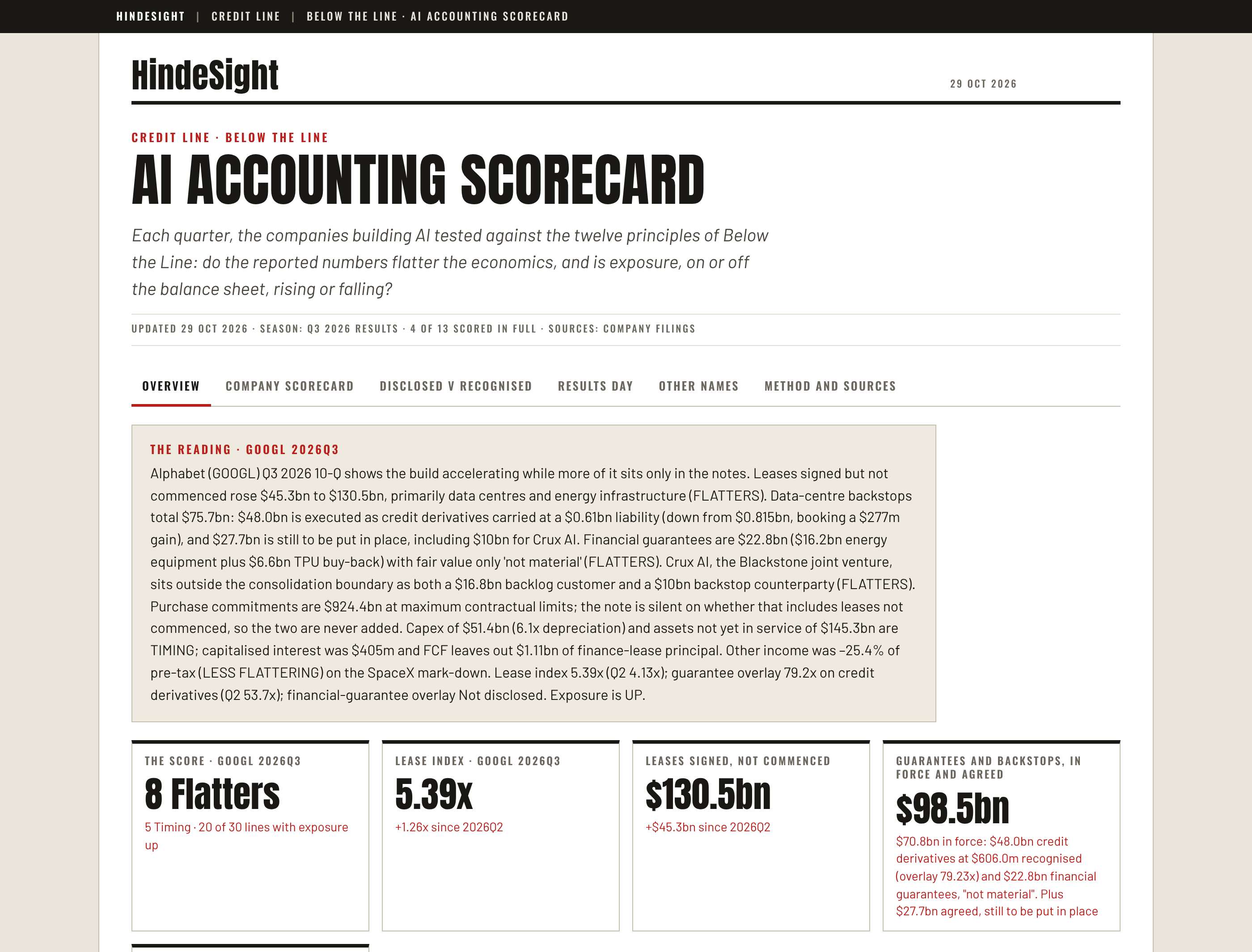
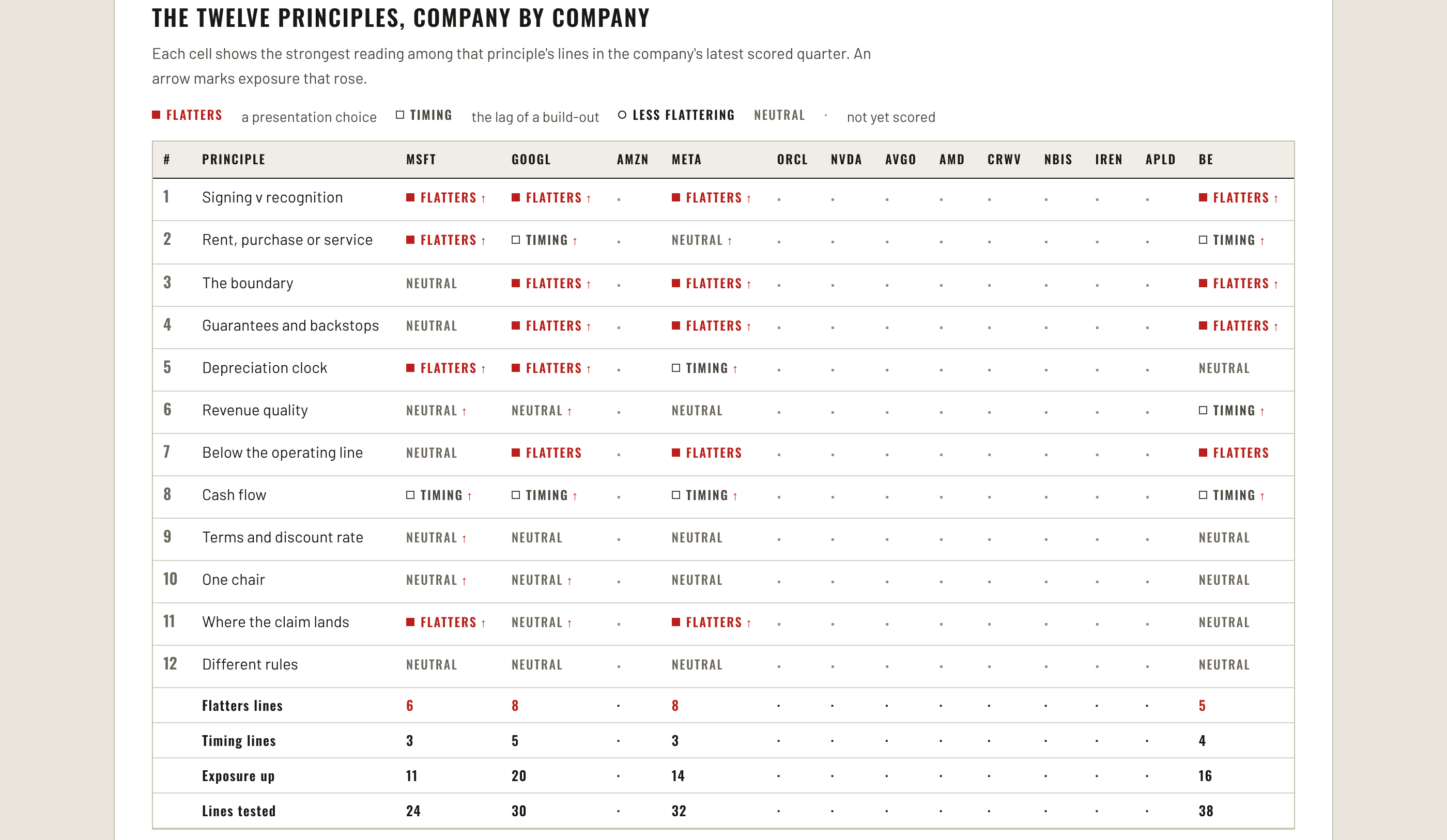
HS Chart NoteEight lines flatter, five are timing, and exposure rose on twenty of thirty. The build is accelerating, but more of it sits in the notes than on the balance sheet.
Alphabet's full scorecard reads 8 lines Flatters and 5 Timing, with exposure up on 20 of 30. The full scorecard, company by company and quarter by quarter, will be published on the new HindeSight site, alongside the letters. Amazon's, scored from its 10-Q, reads 3 Flatters and 4 Timing, with exposure up on 17 of 32: fewer presentation choices than Alphabet, but its exposure runs through its investments in its own customers.
Intel: The Supplier's Capital Reckoning
Intel's quarter shows the same build from the other side of the invoice. Revenue rose 21% to $16.5bn. Data-centre and AI revenue rose 78% to $7.3bn and earned $3.0bn of operating profit, the strongest data-centre growth in fifteen years by its finance chief's account.6 Agents and inference run on ordinary processors as well as accelerators, and Intel says demand for its Xeon server chips is outrunning its supply.
HS Chart NoteDemand for Intel's server chips is the strongest in fifteen years, yet its cash flow is falling. The supplier must finance the factories as well as sell the chips. The financing burden of the build is spreading up the supply chain.
Three things in the results matter for credit.
The first is that the supplier must finance the factories as well as sell the chips. Its foundry, the manufacturing arm that also makes chips for other companies, lost $1.85bn in the quarter, and much of its revenue still comes from Intel itself rather than independent customers. Gross capital spending reached $4.2bn, operating cash flow fell to $5.1bn from $7.0bn in the second quarter, and the finance chief does not expect positive cash flow this year. Intel expects about $20bn of capital spending in 2026 and a material increase in 2027, and has raised $23bn of equity to support it. The financing burden of the build is spreading up the supply chain. As October's Catch-22 set out in its third part, Too Cheap, this is the bullwhip effect. A small change in demand at the end of a supply chain grows into a much larger swing at each step back along it, as every link orders ahead of the one before. The hyperscalers hold the handle. Intel, the memory makers and the substrate suppliers are at the tip, where the movement is largest. They have just added capacity to meet the build, so if it slows even modestly, they will feel it many times over.
The second is crowding out. Intel expects the PC slowdown to last at least through the first half of 2027. In July it blamed flat PC sales on a memory shortage, and a shortage of substrates is now limiting its own output; both are inputs the AI build is absorbing.7 Richard Cantillon observed nearly three centuries ago that new money does not spread evenly. Those who receive it first spend it before prices rise; those further down the line pay the higher prices. This is 'Cantillon in silicon'. The capital enters through the AI build and bids up the inputs everyone else needs, so the PC buyer pays for the data centre before it has earned a dollar.8
HS Chart NoteNew money does not spread evenly. Those who receive it first spend it before prices rise; those further down the line pay the higher prices. In this build, the PC buyer is further down the line.
The third is the step down. Intel guided fourth-quarter revenue to $15.0bn to $16.0bn, below the third. Strong data-centre demand is not yet enough to offset weakness elsewhere, and the supplier's revenue is not independent evidence that the buyer's investment will earn its cost. It is the same spending, seen from the other chair. For Intel, the return will depend on how fully its factories are used, long after today's orders have been filled.
What Would Tell Me I Am Wrong
The strongest case for the build is already in these results: cloud growth of 39% and 103%, and AI that improves the franchises paying for it. If that growth converts into cash, the reckoning becomes a rehearsal.
Three signs would show it. Free cash flow at Amazon and Alphabet turning positive again while their capital spending holds, because revenue has caught up rather than spending slowed. Leases not yet started growing more slowly than the revenue they are meant to serve. And suppliers like Intel funding their expansion from their own cash rather than the capital markets.
Cheaper borrowing would buy time but would not settle it. The question is whether the return on what is being built can catch a cost that was fixed years in advance, while the price of intelligence changes in months. That deserves its own treatment in December, alongside Morgan Stanley's estimate that AI investment by the hyperscalers and neoclouds, leases included, will reach about $1.6trn in 2027.9
The capital has been committed. The returns have yet to catch up.
It appears the money is now leaving the stock market too.
It has been a bouncy ride. In our work at Hinde Capital and at Variant Perception, we used to say that tops are a process, not an event. I believe that process has now ended, and the event is just beginning.
This research is not only about whether to sell, which I have been doing these past two months, as disclosed in September and below. It is about understanding where the value will sit in the supply chain as investors become more discerning. Watch below the line.
Sources
- 1Amazon, third-quarter 2026 earnings release, 29 Oct 2026, and Form 10-Q, quarter ended 30 Sep 2026. ↩
- 2Alphabet, Form 10-Q, quarter ended 30 Sep 2026, and Q3 2026 earnings release, 28 Oct 2026. ↩
- 3Meta Platforms, Form 10-Q, quarter ended 30 Sep 2026. ↩
- 4Oracle, Form 10-Q, quarter ended 31 Aug 2026. ↩
- 5Microsoft, Form 10-Q, quarter ended 30 Sep 2026; fiscal 2026 fourth-quarter earnings call, 29 Jul 2026, remarks by Amy Hood, CFO. ↩
- 6Intel, third-quarter 2026 earnings release, 29 Oct 2026. ↩
- 7Intel, third-quarter 2026 earnings call, 29 Oct 2026, as reported by investingLive; second-quarter 2026 earnings release and call, 23 Jul 2026. ↩
- 8Richard Cantillon, Essai sur la Nature du Commerce en Général, written c.1730, published 1755. The Cantillon effect is a recurring HindeSight theme. ↩
- 9Morgan Stanley Research, Following AI's $1.6 Trillion Money Trail: Mapping the Revenue Generated by the Capex Boom, 15 Oct 2026 (secondary; full report not reviewed). ↩
Trade Disclosure
Equity risk only. Positions entered since 15 October:
- Short the Magnificent Seven (Mag7: AAPL, MSFT, GOOGL, AMZN, META, NVDA, TSLA)
- Short the VanEck Semiconductor ETF (NASDAQ: SMH)
- Long Nebius Group (NASDAQ: NBIS)
- Long GE Vernova (NYSE: GEV)
- Long Bloom Energy (NYSE: BE)
- Nasdaq-100 (NDX) put barbell, December 2026 expiry: long 1× 27,000 put, long 2× 25,000 puts
- S&P 500 (SPX) put barbell, December 2026 expiry: long 1× 7,400 put, long 2× 7,200 puts
Earlier index put positions, disclosed in September, were largely taken off as the S&P 500 dipped to around 7,500, and rolled.
The small print. Worth a read.
This is not investment advice. HindeSight is one person’s attempt to make sense of the world and its markets. As a trader, I will invariably have positions that reflect some of the views expressed here, so there will be occasions when I am talking my own book. I make no apology for that, but it is something the reader should be cognisant of.
I write HindeSight as much for my own edification as anything else. The process of committing thoughts to paper forces me to test a thesis, join a few dots and occasionally discover that some of the dots had no business being joined in the first place. If, in doing so, it helps others frame their thinking or piques their curiosity, all the better.
There is no prescribed publication schedule. The letters tend to be born out of curiosity, conviction or an intellectual itch that needs scratching.
Markets are dynamic and so, by necessity, are my views. It is perfectly conceivable to be tactically bearish and thematically bullish on the same market. Equally, what seemed a compelling proposition on Monday may look rather less so by Friday. There is little virtue in remaining faithful to a thesis simply because one has committed it to paper. The art of trading, as ever, lies in marrying conviction with flexibility.
The objective is not to be proved right, but to make a return commensurate with the risk undertaken, capturing as much of the opportunity as possible whilst giving as little back as possible. Easier said than done, as most of us who have spent a lifetime in markets can attest.
Hinde Capital no longer manages external capital and there is nothing here to sell you. These letters are shared in the spirit of intellectual curiosity and the enjoyment of exchanging ideas. By all means challenge my thinking, but do your own work, take responsibility for your decisions and never take more risk than affords you a decent night’s sleep.
Nothing published here constitutes an offer, solicitation or recommendation to buy or sell any investment or financial instrument. Past performance is no guide to future returns. Readers should seek independent, regulated financial advice where appropriate. To the extent permitted by law, no liability is accepted for losses arising from reliance on this material.
By all means share the letters with your sister-in-law or brother-in-law. Whether you remain on speaking terms is, however, beyond the remit of this disclaimer.
© Hinde Capital 2026.